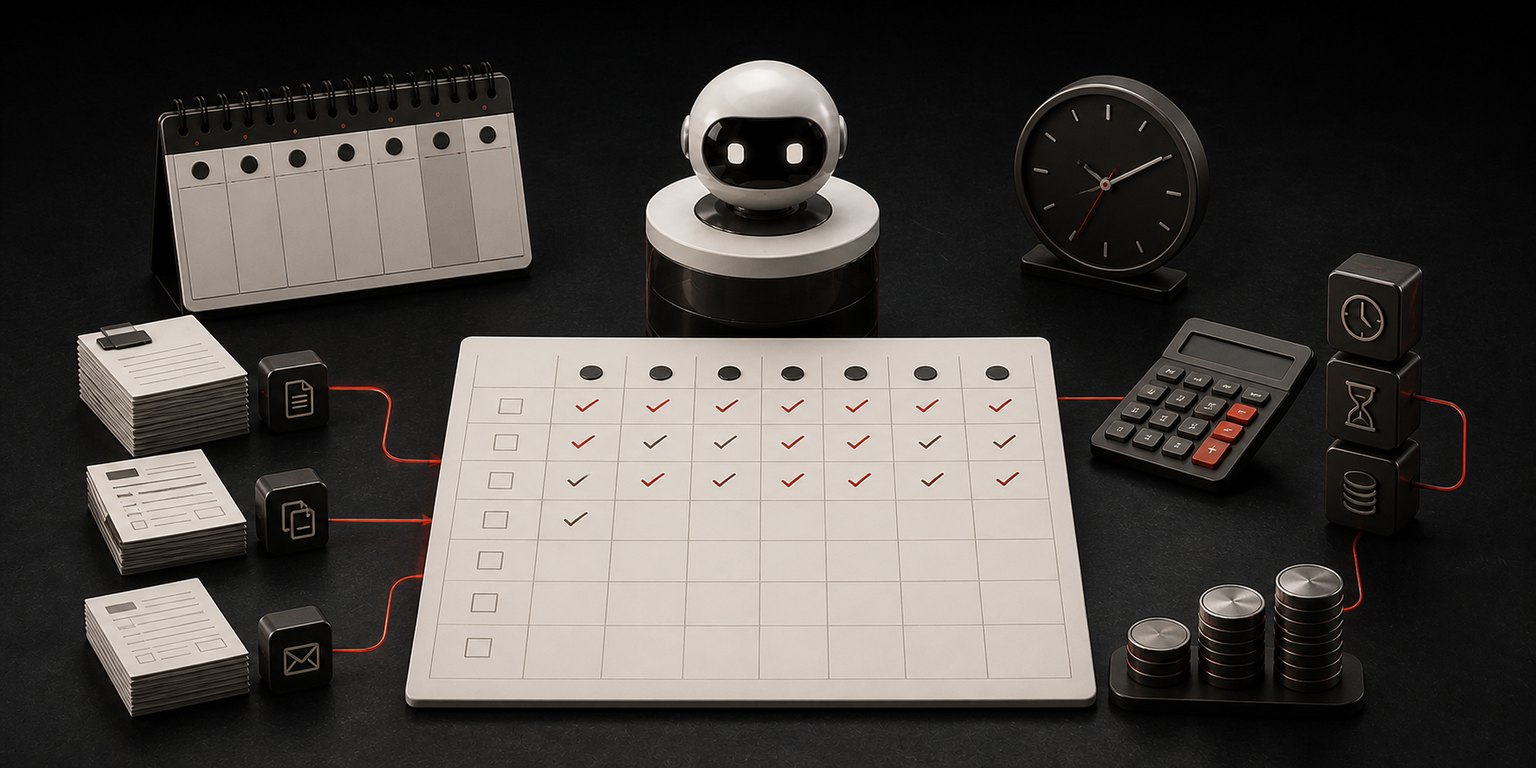
Ask a business owner how much manual work happens in their company and you will get a shrug and a guess. Ask them what their software costs and they will tell you to the krone, because that arrives as an invoice every month.
Manual work never arrives as an invoice. It is already inside a salary that gets paid whether the week was efficient or not, which is why it can run for years without anyone deciding to keep it.
Why nobody knows the number
Three things hide it. The work is spread thin, four minutes here and six there, so no single instance feels worth mentioning. It is done by the people least likely to complain, because they are the ones who take pride in things not falling over. And it has no name: nobody calls it "copying data between two systems", they call it "doing the invoices".
So the honest answer to "how many hours?" is that you do not know, and neither does anyone else in the building. That is not a failure of management. It is what happens to work that nobody has ever been asked to count.
One area, one week
The measurement is deliberately small, because a big one never gets finished.
Pick one area. Customer service, or the back office, or sales follow-up. Not the whole company. For one week, everyone who works in that area writes down each thing they do by hand, as they do it.
No stopwatch. Estimates are fine, and they are accurate enough at this stage: the difference between four minutes and six will not change any decision you make afterwards. One rule only, and it matters: if a program already does it, it does not go on the list. You are counting human work, not activity.
The columns that matter
A row per task, and six columns. Five of them are there to produce the arithmetic. The sixth is the one that changes the conversation.
| Column | What it is for |
|---|---|
| What gets done | The task, described the way your team actually says it |
| Who does it | Shows how many people the area really touches |
| Times a month | Volume |
| Minutes each time | With the previous column, this gives you hours |
| Which programs | Where the work lives, and whether it can be reached at all |
| Rule or judgement? | Whether the task follows a rule, or needs a person to decide |
That last column is the one people skip and then regret skipping. It splits the total in two, and the split is the whole point: some of those hours are work that follows a rule every single time, and some of them need somebody who knows the customer, the supplier or the exception.
Turning the log into two numbers
Times a month multiplied by minutes each time, divided by sixty, gives hours a month. Add up the rows and you have the first number.
For the second one, multiply by what an hour of that person actually costs you. Not their salary divided by hours. The real figure, with employer contributions, holiday pay and pension in it, which is meaningfully higher than the number on the payslip and is the only one that reflects what the hour costs the business. Your accountant has it, or can produce it in ten minutes.
Two numbers come out: hours a month, and what those hours cost you in a year. Then look at the split from the rule-or-judgement column, because the year figure on the rule side is the only part anyone should be talking about automating.
What not to do with it
Do not use it to evaluate people. The log measures the work, not the worker, and the moment your team suspects otherwise the numbers stop being true. Say what it is for before you hand it out, and mean it.
Do not compare one person's rows to another's. Different tasks, different volumes, and the comparison teaches you nothing you wanted to learn.
And do not treat the total as a target for headcount. The rule side of the split is work you can remove from people's weeks. It is not a person.
What the number is for
It is for deciding, with something real in front of you, whether this is worth anyone's attention.
If a whole area comes out at a couple of hours a month, you have your answer and it cost you a week of noting things down. If it comes out at thirty or forty hours a month, sitting in tasks that follow a rule every time, then you know what you are looking at and roughly what it is worth, before a single person tries to sell you anything.
That is the entire purpose. Not a proposal, not a diagnosis. A number you did not have on Monday.
The sheet, free, no strings
Timekart is the spreadsheet described above with the arithmetic already in it. You fill it in, you keep it, and nobody sends you a report you did not ask for.